Showing posts with label culture. Show all posts

Tuesday, September 4, 2012

The Festival and The (sorta) Bullfight

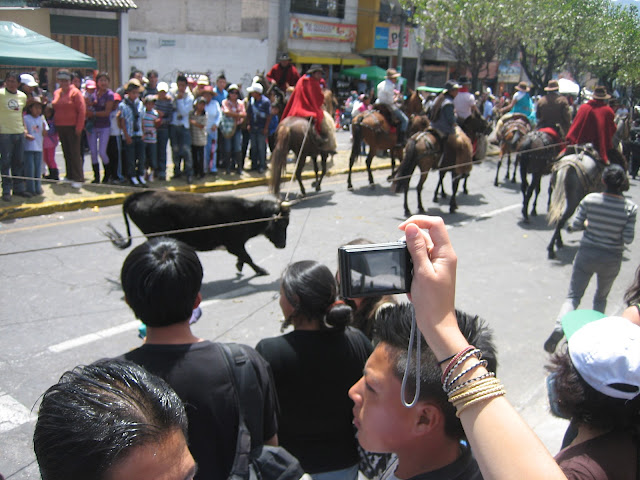
     The usually sleepy town we live in, Sangolqui, was thriving over the weekend for the annual maize and tourism festival. Those two themes don't really appear to go hand in hand but they're the two biggest means of revenue in the region so it's only right to celebrate them together. A group of us woke up early on Saturday morning to hand out flyers advertising our classes that start next Tuesday. We handed out 300 flyers in about thirty minutes so we felt pretty good about ourselves before we settled in to enjoy the parade. While the theme of the parade was the choclo (maize) it was really a show of horse clubs and the bulls that would soon be terrorizing the young, bold, and idiotic men that would be stepping into the arena with the toro. We knew the bullfight would be pretty terrifying to watch, however, none of us were expecting the parade to provide us with a number of scares as well. For every ten calm horses that strode past us, there would be one that was obviously not happy to be there and would rear and generally be impossible to control. We saw on two occasions a horse and rider turn into the crowd, sending the crowds scrambling for safety and on one occasion sending a woman and child flying to the ground. Luckily there were no serious injuries. Those were to come later in the afternoon.

The first horse club

 Showing off of the bull. Animal rights dont really exist here

A reason for the wild horses might of been that four 
year olds were riding them

Either a great cowboy or a terrible horse


     After a light siesta, the entire group minus animal rights activist in the making Joey, headed to the bullfight. Slowly making our way through crowds that numbered in the thousands, the arena suddenly loomed in front of us and the general feeling of excitement was immediately replaced by adrenaline fueled terror. Peter accurately compared the bullring to the first arena Russell Crowe fights at in the movie Gladiator while Sarah went for the Quidditch world cup comparison. The ring had been built specifically for the event and looked as it had been thrown together over night. It's three stories soared about thirty feet into the air with the ground floor reserved for stores selling beer and street food and beer. The second and third tiers were the viewing boxes. In order to reach the seemingly empty box we chose, we had to climb a shaky ladder to the third floor where we crammed in with around twenty other fans. The initial view was breathtaking. The ring was crammed with anywhere between 50 to 100 people, mostly made up of twenty to thirty something year old men. Only a handful had capes while the rest ran pellmell around the ring daring each other to get closer than they themselves had to the rampaging bull. Some, mostly those with the capes, showed real prowess and finesse that even would have impressed Hemingway. However, the majority were drunken thrill seekers who terrorized the bull by running circles around it and provoked it by throwing rocks and trash at the bewildered beast. After a few docile and confused bulls, the crowd began to get what the had been whistling for. A series of ferociously fast bulls took out a couple of the slower boys in the ring. We saw a few men get tossed in the air, some catching a horn from behind, but the bull didnt pursue them so there were no injuries that were too bad. The worst part of the evening had to be when a horse got caught and the bull was relentless in taking it down. You really have to respect how powerful the animal was when it could toss a full grown horse into the air. It was obvious that it was beyond healing but we were spared seeing the ending of its life by the large group of people that encircled the fallen animal. All in all it was a spectacular event to be a part of and made for a fun and culture packed weekend in Sangolqui.

The back entrance to the "boxes"

General pandemonium  

 Cowering men, charging bull


 Pawing the ground

Friday, May 14, 2010

Threads

This week's blog comes from Chet Polson and guess what... it's not about microfinance! I love Chet's blogs about microfinance, mostly because I could never explain the ins and outs of the program as well as he can. I also thoroughly enjoyed reading this refreshing look at life in Ecuador told through the eyes of a wardrobe. Enjoy and cross your fingers that Chet and Mike make it up Cotopaxi (the second tallest mountain in Ecuador) on Sunday morning!


Chet resting atop Pasachoa

"I have a ton of t-shirts. This may not be the most interesting revelation to our readers, but it is something that I’ve had on my mind for the past few days. Sonia and I switched rooms Wednesday to get the PD living arrangements squared away for summer. As I had to take all my current possessions from my old room into the office before finally moving into Sonia’s old room (Erik and Chet’s 'Fort' now) I had ample opportunity to look at exactly what is in my wardrobe.

I have 8 button-down long-sleeve shirts. One each is from Mark and Seth. I have 1 Rumiñahui soccer jersey that I play in on weekends. I have 4 jerseys from other teams (Ecuador, Argentina, LDU Quito, and a YMCA one that is good for hiking). I have a “kick it with Pi-Phi” tank top that I don’t believe I’ve worn since orientation. I have four undershirts and 3 collared polo shirts on top of that (again, two of those collared shirts are from Mark and Seth). All in all, I have 34 shirts here in Ecuador with me.

That is a ton of cotton (or polyester, as the case may be with some). And I have even more shirts sitting in my closet at home. Sure, some of these shirts have very different uses. I can only play soccer in my Rumiñahui jersey, because it is the team uniform. Some of the t-shirts are so ratty I don’t like to wear them outside the house. I try to wear a button down shirt when I’m teaching and wear either a collared shirt or an MPI shirt when I am in the library. But I wear my shirts more than once before washing and do laundry every 7-10 days, so I really have way more than I need.

I’ve learned a lot in my time here in Ecuador with Manna, but something I’m only now starting to pick up on is how to do more with less. Manna already does a pretty good job doing more with less. Of our three children’s English classes, only 2 have boards. But we had enough demand for children’s English that the English profes felt the need to offer a full third class. We have gone from having every PD in the library every afternoon to only having three there to allow us to run more programs and plan for more classes. I hope I can get a clearer picture of how to do more with less in my remaining 76 days. I don’t want to come back with this skill just to be thriftier; I don’t just want to mop my kitchen floor with a little less cleaning solution to save money in the long run. I’m interested in conserving resources because, from what I’ve seen, if you pass your extras along to someone else some really incredible results can spring from relatively small gifts. The art class, which has around 15 kids ages 5-10 coming to the library each week, has had to buy almost nothing because out biggest needs (construction paper and markers) are always being donated. Our English classes couldn’t function without the dry erase markers that get sent down a box or two at a time with volunteers. Some of the clothes I wear most often I got out of the adoption corner.

So thank you donors, and not just my donors, for everything you have made possible this year so far, both in the PD’s lives and the lives in the communities we work with. When I leave Ecuador at the end of July, I want to leave 21 shirts behind. I might even leave more if I can. If another PD doesn’t feel the need to augment their wardrobe from the adoption corner like I did, they will be passed along to Ecuadorians in need. But more than just thanking you for what you’ve already done, I want to encourage you to keep passing along little extras: small monetary gifts, in-kind donations, and even clothing to us (or an organization closer to home) to continue producing incredible results.

Song of the blog: 'Bigger than my body' by John Mayer

- Chet"

Monday, March 8, 2010

Feels Like Home

Despite scurrying in and out of Quito, Mindo, the library, and everywhere in between with our first group of spring break volunteers, Sarah found some time to give us the run down on her homestay experience. Community homestay is a new program for us PDs; we spent three weeks in mid-July living with families in Quito, but now we're taking turns spending time with families in and around our community. This gives us a chance to brush up on our Spanish and, more importantly, expose ourselves to different cultures and extend relationships beyond the four walls of the centro.

"Sometimes I forget that I live in Ecuador. Mike once said that we live in a “little America,” (see interview below) and you know what? He has a point. We speak English in the house. We watch American movies and DVDs (albeit Ecuadorian bootleg versions). We cook what we know – mostly American (and occasionally Indian) meals. And we seem to maintain our fast-paced lifestyles in the midst of a country where la hora ecuatoriana (i.e. everything is late) dominates.

Last week I got a taste of Ecuadorian culture 24/7 while I was on my home stay – living, eating, and playing with an Ecuadorian family whose kids attend our children’s English classes. I was the guinea pig PD, as I was the first one to leave the shelter of our little America to live with community members. And I am happy to report that it was a phenomenal success!

Each evening, instead of piling into the camioneta bound for home, I jumped on a bus to Sangolquí and arrived at my new home just in time for dinner. I lived in one home with two parents and one daughter, but we were surrounded by the entire extended family. Within this small block of Sangolquí lives roughly 35 members of the same family. This means lots of cousins, lots of little kids, and lots of playing.

After dinner each night, I played made-up games with the kids (so funny how kids make up games… I miss that!) that ranged from playing “basketball,” where an arco was made by hitting a circle on the wall made with chalk, to “nombre” which involved a lot of running and throwing a ball at each other, to good old jump rope, which was probably a bad idea after eating such a huge dinner.

The weekend brought more cultural immersion, since last Saturday was Flag Day at school. From what I gathered, Flag Day is something that all students do on a selected day every year. They march with the flag, sing their National Anthem, and honor the students who are at the top of their class. One of the cousins with whom I was living happened to be at the top of his class, so he got to lead the march and stand in the front. The whole day turned into one big celebration – a big family lunch, lots of talking post-lunch, an afternoon in the park, and cake in the evening.

I left my new family on Sunday to travel back to the Manna House where a meeting and cooking responsibilities promptly greeted me at the door. It was good to be home and with my housemates whose screams and general absurdity I have come to love, but it is infinitely better to know that I have a family in Sangolquí that asks me every day in the library when I’m going to come back to visit and play games in the courtyard.

-Sarah"

Tuesday, March 3, 2009

Museum Adventures with Vanderbilt

Tuesday

We started the day with a late morning, homemade french toast, and english class lesson-planning while piled on the couches. After Dunc headed in to Quito to pick up our banos tickets for this Thursday, Alaina, Kira and I stopped by the local venta to pick up supplies for the evening's fruit salad (for some reason our cook came to the house at 8:30am to start dinner preparations and clean the bathrooms...apparently she thinks she needs to invest a lot of time to make us clean/well fed) and walk around Conocoto a little bit.

Everyone was out the door by 1, posters and glue and paintbrushes in hand in order to advertise for the upcoming teen center/library grand opening concert on our way to the Casa Barrial. After a few rough starts (not a good idea to try and paste a poster to a wall with severely chipping paint flakes), we got the hang of it, which will come in handy tomorrow during round two.

At 2 we met with the 14 students from my art class for a really special field trip to the Guayasamin art museum in downtown Quito. After piling all 25 of us (and Mafe's dog, for reasons we're still not quite sure of) into a far-too-small van, we were on our way... first to Conocoto to trade up the van size, then through the maze that is downtown Quito, and finally to the top of a far hill and the base of the museum's grounds.

The museum itself was a force of emotion. As it was my third time visiting, I expected the waves of emotions to hit me with a little less force, and yet each visit is an island unto itself, an experience encapsulated in the present and incredible unto itself. Walking through the museum with my students, who just last Thursday studied Guayasamin in class and created their own interpretations of his works, and listening to their responses to our guide's questions and their enthusiasm for what they were seeing was indescribably wonderful. And it was even sweeter to experience it with the Vanderbilt girls.


After a long bus ride back (made worse by the expulsion of all the pent-up energy the kids had kept a cap on during the museum), most of the girls headed home with Dunc, while Alaina, Kira and I (my two new fabulous cohorts!) headed up to the church for women's exercise, an hour that left us aching in the legs and wondering how Serena does it 3 times a week.

I just left the group up on the roof around a bon fire, roasting marshmallows, making smores, and dissecting their time down here thus far. Such rich conversation, challenging questions, and positive discussions we've had so far, I can't wait to see where the rest of the week goes. And (big news!) Dunc and I still love each other! We haven't fought yet! Best co-leaders ever :)

Until tomorrow,
Holly

Thursday, February 12, 2009

Neither Here Nor There

(Today's guest blog comes from Mark Hand, Country Director extraordinaire)

Men in Botswana holds hands to display their purely platonic friendship. In Scotland, as in the rest of the UK, cars drive on the left side of the road. In Nicaragua adios ("to God," literally) means hello and goodbye. In Louisiana, the southern gentry stand by their chairs whenever a lady arrives at or departs from a table. Travelers both seasoned and novice note these sorts of cultural quirks. Sometimes they are just that – quirks. Often, they point to deeper cultural currents.

In my travels, these quirks have always been amusing, and at times thought-provoking to me. While in Nashville last week, for example, my sister would physically push me away for walking too close to her on the sidewalk; an amusing notion, and one which in more thoughtful moments could lead to a discussion of the quintessentially North American need for personal space.

This trip back to the US, which I spent at a conference in DC and in MPI's first organization-wide conference in Nashville, was the first time I have paid more heed to those quirks in myself than in my surroundings. When in an uncomfortable formal situation, I used to find myself reverting unconsciously to my training as a southern gentleman; now, however, I find myself acting more like a polite Ecuadorian country boy. When I walk into a room it feels more natural to greet evry last person – the men with a not-too-firm handshake, the women with a single fake kiss on the cheek – than to slip in quietly, shake hands with those in close proximity, and nod in recognition to those who make eye contact from across the room. When I make physical contact with someone on the metro (a grave offense in the US, apparently) my immediate reaction is to say perdoname rather than excuse me. And man, driving in the US is boring.

I am back in Quito now, interviewing an excitingly strong group of applicants for next year's E-team. And instead of coming back with open questions about the differences between Ecuador and the US, I come wondering about how I fit into both – or neither. So Mom, if I stand up at the table whenever you do, but then attempt awkwardly to kiss you on the cheek, you'll know why.

Wednesday, December 3, 2008

A Day in the Daily Life, Pt. 2

(Today's guest blog comes from Eliah, who purposefully switched with Dana so he could make us all feel like crap about attending the annual bull fights. Thanks, E.)

"To lead off today´s blog entry, I´d like to talk about about Ecuador´s culture of animal cruelty. It starts with the dogs. Come to most any town in Ecuador and you´ll invariably cross paths with dozens of street dogs, some strays, some permitted to roam by their owners. You´ll also notice that they´re annoying. They carry disease, they bark, they make you watch where you step on the sidewalk. And they´re mean—Dunc was bitten twice in one week and I won´t walk home from English at night without a handful of rocks. It´s enough to make dog catchers sympathetic figures. But it´s not their fault. The way this society approaches its canine companions is practically designed to produce unfortunate conditions.
A partly understandable component of this approach is that Ecuadorians don´t own dogs as pets but to guard their homes. And while this may come at the expense of a few pounds of gringo flesh, at least the bureaucracy here is cumbersome enough to dissuade us from suing. Because they have utility, however, doesn´t mean dogs are well treated. Quite the opposite, many cower at almost any motion in their direction while the best way to halt a menacing Ecuadorian dog is bend to the ground. They´re so used to this action being followed by a hail of lithic pain that most instantly turn and run. In a not uncommon instance, I recently saw one of the neighborhood kids throw a wrench as hard as he could at the head of a dog on the other side of the street. The dog, which was not causing any kind of trouble, could have easily been killed and the act seemed to be more out of boredom than malice. Meanwhile, the government does almost nothing to help the situation. Without any system of animal shelters, dogs are left to roam and reproduce, with, I´m told, the exception in Quito of the annual random distribution of poisoned meat, a practice that in the US is most commonly used by creepy antisocial neighbors but has yet to be adopted by the Humane Society.

Of course this disregard for the well being of the country´s non-human inhabitants is not exclusive to dogs; as is often the case, what sparked today´s focus on animal cruelty was my fellow PDs. The past couple weeks almost all other members of Manna have attended the popular bull fights here, which I view as paying for and taking pleasure from watching the torture and execution of a bewildered animal, and which they tell me is justified because it´s "artistic." Unable to keeping them from attending the event, I can only hope, as any good environmentalist does, that I at least take some of the joy out of it. That and use this space to rant about it. Which is why no one likes to live with an environmentalist.

But on to my day. Today´s daily life actually began yesterday, in a conversation with Marilyn, the mother of Ximena, one of the Apoyo Escolar students. Like all our programs, Apoyo is an outlet for us to help the people in the communities where we work, but which at times, reminds us of the complexity of the problems they face and our own limited ability to impact them. Marilyn came to pay the monthly $2.50 fee we use as an incentive for parents to make their kids come, but also to ask about Ximena´s behavior. Ximena is one of the more troubled kids at Apoyo—she routinely refuses to talk to us or do her homework and once told us her parents would beat her if she had unfinished work at the end of Apoyo—and Marilyn said she is aware that she should probably see some kind of expert. Like most Ecuadorian children in need of special help, however, Ximena has never been evaluated by any kind of professional, and Marilyn told me she doesn´t have time to take her. Since we live near a branch of the National Institute of Childhood and the Family (INNFA), an organization that employs such experts, I suggested we could take Ximena for her, and she agreed.
So today, I headed over to the INNFA building and sat down with Dr. Ibarra, a child psychologist, to discuss Ximena. Dr. Ibarra was skeptical of talking to a child without her parents present due to the frequency with which behavioral issues in Ecuador stem from parental abuse. Under the circumstances, however, she agreed to schedule an appointment for the next week, though the price of $4 per session worried me that Ximena´s parents wouldn´t want to pay for her to go more than once. That might not matter, however, Dr. Ibarra told me, as she only had time for three visits—in January, the government is taking INNFA over and along with most of the other workers there, she will be fired.
INNFA, she went on to explain, is the largest NGO in Ecuador, with over 1400 employees across the country doing work with street children, battered women, troubled children, health issues, and agricultural education, and making access to high level specialists affordable in under-served communities. However, part of its funding comes from the federal government, something which recently resulted in an executive order, allowed for by the new Ecuadorian constitution, nationalizing it along with all other NGOs receiving public funding. Most of INNFA´s employees will be fired and it will be run, she told me, like an Ecuadorian public hospital. In other words, poorly.
Which brings us back to Ximena. When you consider her problems through the prism of INNFA and what we know about her from Apoyo, things look bleak. Her schools are inadequate for a special needs student, her parents are likely abusive, her culture doesn´t expect her parents to take her to a specialist, her economy likely precludes them from doing so anyway, and her government is removing what little civil society exists to help her. Perhaps worst of all, her own circumstances are not exceptional enough to draw attention or outside help.
Meanwhile, in the Manna house, we live in a Third World country, we speak Spanish, and we are confined to the same two types of tasteless cheese as everyone else here, but thanks to our advanced schooling, caring parents, protective culture, First World economy, and benevolent government, we are immune from the long term side effects of normally accompany living in this place. So in very many ways, it´s like we never left the US at all. And that´s the way it should be, for us, Ximena, and everyone.
Eliah"

Friday, November 28, 2008

Can't Move...

(our newest dinner guest)

Current locations of all MPIE PDs:

Jocelyn: Horizontal in bed, Perez Hilton up on her computer screen and dreaming about pumpkin pie.
Eliah: Horizontal, watching James Bond and avoiding the compost pile.
Serena: Horizontal, still eating turkey, watching James Bond.
Dunc: Horizontal, talking to himself about the Jalepenos his mom sent and chocolate pecan pie.
Dana: Sound asleep sitting up in a chair, "watching" James Bond.
Mark: Doing more dishes, wishing he was horizontal.
Holly: Horizontal on the floor, watching James Bond and attempting to write the daily life blog.
Seth: Who even knows, he went home and celebrated Thanksgiving yesterday. We miss him.
Chris: Horizontal, silently memorizing the lyrics to "oh holy night" as sung by Cartman from South Park. And watching James Bond.

Since we have 4 programs in the community every Thursday (Apoyo, English conversation, English for adults, and Women's Exercise), we decided to 'postpone' our Thanksgiving celebration until today. This was decided after we realized that the smallest turkey we could purchase was 25 lbs. and would take essentially all day to cook...ie. we would all need to be in and out of the kitchen making our respective side dishes starting at 8am (guess who got that lucky shift) until 5;30 dinner time.

I love the eclectic nature of life down here; my Thanksgiving day started with an 8am bike ride to the local market to buy fresh green beans, continued with my first attempt at chocolate-pecan pie and handmade pie crust (thanks for the rescue, Jos!), transitioned to a cab ride into Quito to join the hundreds of Ecuadorians watching day one of the Festivals of Quito bull fights, which subsequently led me to slight dehydration and nausea at watching 6 bulls die in 86 degree Ecuadorian sun...after which Jos, Serena and I piled into a cab, swung by the Mariscal to pick up Paul, a friend from Colorado living in Quito for the next year as well, and headed home to put our dishes in the oven and get ready for our feast.

And, judging by everyone's current positioning, it was an absolute success. Chances are pretty low that our leftovers will last past tomorrow...sorry Seth.

Pictures to follow, when I can muster the strength to climb the stairs and get my camera cord. But I don't think that will happen until next week, based on how full my stomach is :)

(Thanksgiving delights)